Tag: antenna

DUX Homebrew Arrow Yagi

radio : by Tommy — August 7th 2010, 11:36PM
radioDUX Homebrew Arrow YagiThis summer I attended the TI-2 Space workshop put on by the ARRL and DARA in Dayton, OH. We spent 4 days learning how to make contacts with orbiting satellites like AO-27, AO-51 and the International Space Station, just to name a few. The antenna we used was the dual-band Arrow II Antenna. I've owned one for years and really like it. I wish more people had them, but I think most people think spending $140 for an antenna that can only handle 10W is a bit much.

My aim was to make a cheap alternative to the Arrow that is easy to break down for transport and storage. I really like the idea of using aluminum arrow shafts for elements; they are lightweight, straight, weather resistant, and fairly inexpensive. Another nice feature is the #8-32 threaded insert for broad heads that almost every arrow comes with.

I spent a couple of hours reviewing all the "cheap" and "ugly" yagi designs, as well as others like the "tape measure" and even a new-to-me "backpacker" design. They each have their own advantages and loyal followers.

I finally based my antenna design on one found in the ARRL Handbook from 1999. While not an exact replica, my design is very similar. I had decided to go with the through-boom design like the Arrow, as opposed to side-mounted because it is, in my opinion, cheaper. After buying 6 arrows and a quick trip to Lowe's I had a length of #8-32 all-thread and a piece of 3/4" conduit to use as the boom. I marked a straight line down the center of the boom to give me a point of reference, measured out the spacing holes, made sure I was drilling square and level and got to work. After the 3 holes were drilled, I cut 2.5" lengths of all thread for the director and reflector. Since I was going with the split driven element design of the IDX yagi, I would not need threading for the Driven Element, I'd use machine screws for that. Originally I planned to use nylon 8-32 all-thread to go through the boom for the driven element, and feed each side independently similar to the Tape Measure Yagi, but I couldn't find nylon all-thread, and the longest nylon screws to be found came up an inch too short.

I cut a length of RG-58 cable and soldered on two o-ring connectors to slip over the machine screws before screwing on an arrow.
Lastly I cut each arrow to the appropriate length, which worked out to:
- 19 5/8" for each Reflector arrow
- 18 1/8" for each Driven arrow
- 17 1/8" for each Director arrow
The measurements came from IDX's lengths, subtracting 3/4" (for the boom) and then divided by 2 to give me the necessary length for each arrow.
I used a cutoff wheel and my air compressor to cut the arrows to length instead of a hacksaw. The cutoff wheel leaves a clean cut as opposed to sawing.

After putting my MFJ-269 analyzer on the yagi, I found the lowest SWR to be about 1.4 right around the target frequency of 144.490 MHz. Not too shabby for a first yagi.
For those taking my lead, I found it helpful to feed the yagi as perpendicular to the boom as possible. It is also somewhat important for the O-ring feedline connectors to be on the same side of the boom as the arrow.

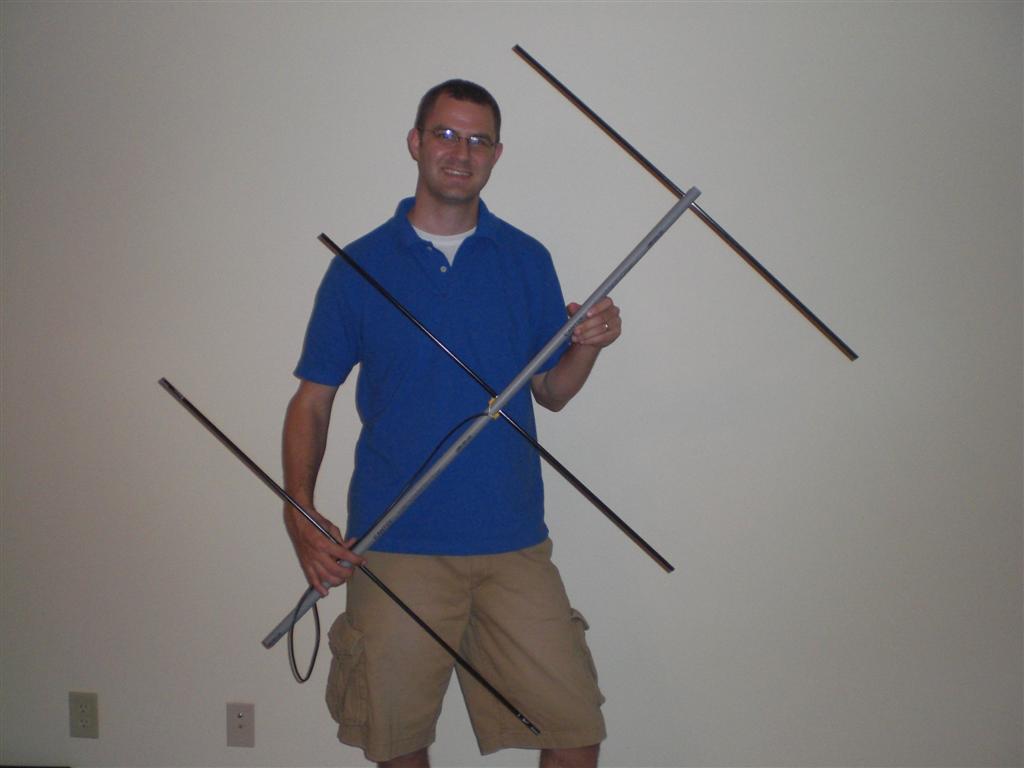
Here's a pic of me holding the 2m yagi. It's a bit larger than the commercially made Arrow.
update: I've been asked by more than one person why the split driven element. As you read above, it was semi forced on me by necessity. I needed it to be split for mechanical reasons. the screws going through the boom serve as a match, negating the need for the "hairpin" match from the tape measure yagi or a gamma match. The driven elements being split probably do affect the radiation pattern in the long-field, but perhaps only skew the pattern more in one direction.
(TLDR: it's easier that way and it just works!)

update #2: Hello Hack-A-Day! Yes, you can talk to the space station and many other amateur radio satellites.
update #3: Okay, for those that are interested, I'll be putting together kits if you want. Price to be determined based on what you want/need. You can email me at tommy@neodux.com for more info.

Arrow Antenna

radio : by Tommy — April 13th 2007, 11:31PM
radioThis past Thursday afternoon I received my new Arrow Antenna. It's a dual-band (2m/70cm) handheld yagi antenna made from aluminum arrow shafts for making contacts with amateur radio satellites. What? You didn't know there were ham radio satellites? Yep, and there's more than one.

Using Heavens-Above, I can find when each satellite will be making a pass over my location as well as the angle and direction of the approach and apex. About an hour after I got the antenna, AO-27 was making one of its daily passes over me. I made sure everything was in order, set my radio to the right frequencies and walked to the field across from my house. Right off the bat I heard guys in New England talking with guys in Florida. Most everyone on the air was using a handheld with relatively low power (under 5W, which normally isn't enough to even get you across town). After just a few minutes I heard my chance to throw out my call. Right away I had two stations come back to me. First time to ever hear the satellite and I was making a contact on one. Unfortunately I didn't have a free hand to write down his callsign and I forgot it! Oops!

How does it work? Essentially the little satellite takes my signal and rebroadcasts it like a ground-based repeater does, only it's up - way up. Because it's up so high, it can rebroadcast my signal to most of North America. To hear me all the other station has to do is listen on the "downlink" frequency.
Really it doesn't take any special antenna to allow this, it's just this antenna is very efficient and easy to aim at just the right spot. Sometime in the future I'd like to try to make an altazimuth mount to automatically steer the antenna for me, but that's way down the road. For now I'm just looking forward to the next satellite pass!

Isotron 40 Antenna

radio : by Tommy — February 4th 2006, 09:58PM
radioI've finally got back on the air in the HF bands. After over 6 months of not having my radio reach any further than the local 2 meter repeaters (maybe 20mi away max), I finally have an antenna that lets me talk outside the state.

I bought a used Bilal Isotron 40 meter antenna from W6KIP off eham.net. I received the antenna after over a week-and-a-half long trek through the incredibly slow USPS shipping machine. That was on Friday, February 3. I assembled it and began thinking exactly how I wanted to mount it. I finally decided to mount the short "mast" (if you'd call it that) on one of the 3 vent pipes on the roof. I'll post a picture of it soon.

Part of my reason for using Isotron was the small size (only 22" wide). Looking at the antenna, you wouldn't even know it was an antenna, it looks more like a weather vane or birdfeeder. Being on campus, I didn't really want a very conspicuous antenna if I could help it. I haven't quite finished fine tuning the antenna, but I can do that as soon as I get my hands on one of the local ham's antenna analyzer.

I haven't made any contacts on it tonight due to an overwhelming amount of static on the 40-meter band. I've listened to a couple of nets, one on 7.2335 said that this is the worst noise they've had all month - what luck!

Update: Well, it turns out the noise isn't just on the band, although that particular night was particularly bad. It seems that the high level of noise (aka static) that I'm receiving is due to a local area thing. Most likely due to the power lines nearby. If I can pinpoint the source of the interference, the power company is obligated to resolve the harmful interference.

Update #2: It turns out it must be the power lines, I was able to go to the front of campus, shove the antenna in the ground and it received beautifully (for an antenna shoved in the dirt). Now, to find that pesky power line pole.

Update #3: Wow. So I called the power company and, not surprisingly, the service rep didn't have a clue what I was talking about. She tried to tell me that the power company has "the right of way" and that I just had to accept the interference. As politely as I could, I told her I didn't and that it was the power company's responsability to at least investigate the interference. She asked what kinda of amateur radio antenna I had, as if it mattered. She asked if any of my neighbors were experiencing problems on their radio. (wtf?) I told her I'd like to hear back from someone that understands about radio interference and what causes RFI on power lines. We'll see...

Update #4: The power company did send a guy out today. He called before he visited. I told him I'd be in class. After explaining the issue to him, he said he knew where my apartment was, and that if it's the powerlines I described to him, they belong to the university, and not Swepco. I had to get to class, but he said he'd leave me a note on my door. He came out, and it wasn't their powerlines. (I'm pretty sure he was right about the university being in control of the lines in question...) Now, to find the person in charge of the campus powerlines and go about getting them fixed in a way that won't get me evicted.