Category: news

Slicklister is live

news : by Tommy — October 3, 2026, 10:06 pm
newsSlicklister Preview It's finally live! Today I launch Slicklister to the world. Slicklister is a project that's been on the back burner for a long, long time.

Slicklister is a list of links you find yourself regularly going to. Maybe it's your personal webmail, maybe it's your work webmail or ticketing dashboard. For me, it's a lot of news links, and special interest links I like to visit routinely. My page is here if you want to see what it looks like when setup: https://slicklister.com/tommygober (you can also just click on Links up at the top of Neodux).

The project started because I had a static HTML page that I kept on my local system, then moved to my webhost. I figured others might have a similar use-case, so I put all the links in a database and made the page pull those links for the user that link belongs to. Using a draggable interface through a JavaScript library Google first released well over a decade ago, I figured the UI can be simple and somewhat intuitive. It's not going to change the world, but I figure it might make someone's life a little more convenient. With most browsers sync'ing user profiles in the cloud, there may not be as much demand for the site as when I first envisioned it; but it's still something I use daily and set every personal web browser to use as the default page on start up.

So here we are. For the past 8-10 years, I've manually created links for myself, a couple family members, and a friend for years, but today you can create your own Slicklister page from the main Slicklister page and I even have a little script so you can enter your ZIP code to get started with some basic links relevant to your area like weather and movies. I hope some of you find utility in it and let me know if I need to add or revise any features!

Life ProTip: Converting Unused Gift Cards

news : by Tommy — October 12, 2018, 1:32PM
newsThis week I came across some unused gift card money on some pre-paid Visa giftcards. We're talking scraps - like $2 on one card and $1.63 on another. In total, I had about $15 worth of credit spread across these gift cards.
At first I had the same thought "$1.63 isn't even worth it" - but $15 is, right? Now, I do a lot of buying from Amazon (as do a lot of people), but Amazon does not let you split a charge across different credit/debit cards. Then I discovered a clever way around this problem. Enter Amazon eGift Cards!

Using my prep-paid gift cards, I purchased Amazon eGift Cards and emailed the credit to myself. At first glance it looks like you can only buy in denominations of $25, but there's a box that allows you to specify an amount (so long as it's greater than $1). Again, Amazon doesn't let you spread a purchase across separate payment types. However, it does let you combine Amazon credit and your normal payment method. I was able to apply the $15 to my purchase which was a pleasant surprise when I ended up only paying $1.99 after applying my newly discovered giftcard money.
So, next time you find some left over giftcards or a modest mail-in rebate (which are increasingly coming back to you in the form of these prepaid cards) and you want to cash in on them, remember this handy workaround.

Higher Ed Enrollment Database

news : by Tommy — September 3rd 2013, 11:45PM
newsThis is something I thought today during a meeting...

I recently learned we have had several students not report *all* institutions they've attended before. (Ex: One student "forgot" to mention they had taken courses with Univ of Phoenix for ~70hrs and stopped attending. Univ of Phoenix is holding that student's transcript until they settle up on their bill. [Transcripts are the one thing a school can hold over a student for failure to pay.] It came to light when the student's Financial Aid was processing...)
School's usually require this because prior scholastic work is taken into consideration when placing the student in courses, academic standing, etc. and ensures a students will make good on their financial obligations - like a gentlemen's agreement among institutions. I asked in our Registrar's office what happens if a student doesn't divulge all schools they've attended, "What's the worst that could happen to them?" "It could get them suspended from our school." In the grand scheme of things, so what? They could move down the road to another school and take classes there. It would be a huge headache for the student, but a driven and motivated student could navigate the system and get their degree one way or another from some institution. (especially from certain schools that are willing to do anything to get money and could care less about the other schools down the road...)

So. What's the big deal? The trouble is Financial Aid fraud.
Unscrupulous individuals will solicit the school for financial aid, scholarships, grants, etc. in hopes the grants and loan money comes to them directly and/or any overage in scholarship/grant money gets sent to them directly, all the while never intending to *actually* take classes. Before any financial aid is disbursed, the student will usually sign a short-term loan with the school to cover the courses in the meantime. Once they're counted "present" in class, the Financial Aid will pay out, the short term loan is dissolved and federally backed funds cover the expenses. If those funds get intercepted by the student somehow, (I'm no expert on FA fraud.) the school has loaned out money for books, living expenses, etc, expecting to get the federal money. However, that money never materializes and the school is left holding the bag.
The fraudulent student will repeat this process at one school after another for quite sometime, never reporting their prior enrollments for obvious reasons.

If there was a way to report a student's enrollment, I believe part of this fraud and waste in the Financial Aid system could be cut.

It seems to be that there should exist some sort of central database wherein schools can mark that a student was enrolled for X semesters at their institution and if they are in good standing or not. (Almost like an academic credit reporting system.)

The Academic Records office at each school would submit to the database the student's name, social or ID number, place of residence and status.

This could be beneficial in several ways:
  1. A student would have a tougher time "gaming" the system as stated above.
  2. A graduate of a school could easily verify their degree and alma mater without submitting transcripts. (At the click of a button employers could check where/when an individual attended.)
  3. students looking to claim residence to avoid "out of area" tuition would be flagged for the residences on record.
  4. Law enforcement/immigration officials would have another easy-to-access paper trail to follow.
  5. colleges would have a snapshot view of a student's academic history with contact info for each of those record-keeping institutions.

It would definitely require a joint effort by all institutions for this to work, much like credit reporting; but it would be for the betterment of all higher education, across the board. Perhaps the Department of Education could organize it? Maybe accrediting bodies would require their schools to submit to this federal register. Or they, themselves, could own databases which are shared among the accrediting organizations as stipulated by the US DoE.


Neodux Mobile

news : by Tommy — January 13th 2010, 11:49PM
newsAs any of you reading this on a smartphone may have noticed. Neodux now comes in a leaner version: Neodux Mobile.

By examining $_SERVER['HTTP_USER_AGENT'] report for elements that reflect the most common mobile browsers, I can detect (usually) if you're viewing the page from a mobile device. (Blackberry, iPhone, Android, WinCE, PSP, Kindle are all supported.) As of this writing the layout is very spartan and only the main posts are displayed. Users cannot login to leave comments or shouts at the moment, but I hope to add that in the future. For now, it's just the core content of neodux but it loads much faster.

I'd label it alpha for the moment, but it should make reading any posts from a smartphone, Kindle or PSP much easier.

Texas is Growing (hands off)

news : by Tommy — December 21st 2009, 11:33PM
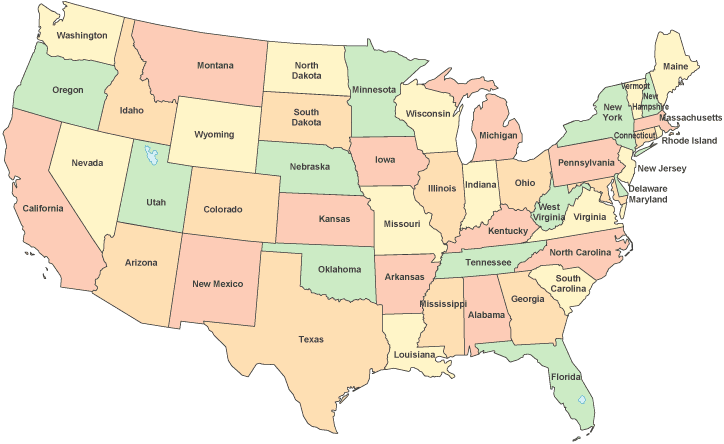
newsSo the other night I was thinking about the map of our United States of America. I began to ponder just how states' boundaries are defined. Some states are defined by rivers, lakes and other bodies of water. Some states are defined by man-made boundaries (which can lead to some interesting disputes).

Currently, Texas' western boundaries are defined in the Compromise of 1850 as "that which is south of the 33rd parallel, and that which is south of the 36°30' parallel north and east of the 103rd meridian west." The eastern edge of the panhandle lies along the 100th meridian west. To the south, Texas has the natural boundaries: the Rio Grande and the Gulf of Mexico (src: Treaty of Guadalupe Hidalgo). Along the north, a natural border to Oklahoma exists along the Red River. To the East we have the Sabine River from the Gulf up to the 32nd parallel, then straight north to the Red River (Adams-Onís Treaty). Interesting, but so what? Plate Tectonics.

In the early 20th century, geologists developed a theory that described continental drift. They dubbed it Plate Tectonics. It has been discovered that continents do move, so naturally so does everything on them. Texas, and the vast majority of the United States "lower 48" (plus Alaska) ride on the North American plate. The North American Plate moves at about 1.5cm/yr more or less toward the Southeast. This means that Texas is slowly taking land away from New Mexico while losing land to Oklahoma and Louisiana. Texas will not lose land to Mexico, thanks to the natural boundary, the Rio Grande (which rides on the plate). Astronomical longitude/latitude lines do not move (they are based on the proximity to the poles and prime meridian (which is physically drifting too, but now there exist astronomical definitions to account for this) Because of this, the land that moves under the aforementioned longitude/latitude boundaries become, in essence, Texas.

Because of these findings, I hereby proclaim that at the time of this writing, I become sole owner of unclaimed lands that move into the boundaries of Texas. Hands off.

update: By my rough calculations, in 69,971 years I'll own all of present-day Texico, NM; and in 1,399,429 years I'll own present-day Clovis, NM. (I will cede Cannon AFB to the federal government.)

update #2: I also claim ownership of all lands that have entered the Texas boundaries dating back to the formation of said boundaries (1850). That should give me a strip of land about 6 ft of land about 241 miles long (assuming 1° is about 69mi) plus whatever land runs along the line from El Paso to the Pecos region.
2009-1850=159yrs, 159yr*1.15cm/yr=182.85cm ≈ 6ft