Category: radio

HOWTO: Getting Started with CW

radio : by Tommy — October 18th 2011, 05:50PM
radioIt's been a year since my post about Morse Code: Brief History, and I figure I might as well shed some light on how to get started operating with Morse Code. Since the Morse code requirement for ham radio was lifted in 2007, the number of amateurs getting their HF privileges has grown substantially, but with the "repeal" of code, entry level Technicians are granted privileges in certain portions of the bands. Most commonly, Technicians can operate SSB in the 10m band, but can also operate CW, or Morse Code, in 80m, 40m, 15m, and 10m. So, if you're a ham, you already have privileges to operate CW - you just need to learn where to start.

Learning the Code
For starters, you will need to learn Morse Code, one way or another. (duh.) While it may not be the universally agreed upon best way, I learned Morse Code through the Code Quick program. It really is an easy way to learn and quickly remember the code. There are countless gimmicks and "5 Minute Ab"-type programs that try to rush you through the learning process as fast as humanly possible, but few are ever successful. You just can't hurry the learning process. The downside of the CodeQuick method is not immediately known until you're trying to copy signals that are faster and faster. Once you hit about 10wpm, the CodeQuick lessons that you've used as a crutch finally become a hindrance and make copying code faster more difficult. The big plus is how quickly you'll learn the code in relatively enjoyable lessons compared to other methods.
Another alternative to learning the code is one of dozens of Koch method trainers. The Koch method, and most others, ram the code into your head seemingly through brute force. You learn the code, but for most people it simply is not entertaining or enjoyable as CodeQuick. However, the hard work you put in up front pays off in the end as you are able to increase you speed with relative ease compared to the CodeQuick program. So it's all about where you want to put in the work, now or later. Because most people because frustrated or quickly lose interest with other methods, I recommend CodeQuick in spite of the "plateau" effect you encounter when trying to speed up your copying skills. Unless you enjoy learning it, the learning curve is almost insurmountable.

There really is no substitute for the "sweat equity" you're going to need to put in to learning the code. It will take time to learn, there's no magic pill. I listened to the CodeQuick training lessons when I was in the car by myself. I wasn't bothering anyone else and I could pass the time by learning something. So consider your personal schedule and think about when you might have time to idly study code.

Copy, copy, copy
Knowing the characters and having the recall ability are helpful, but you still need to try some "live" copy. That is, it's easier to send letters when you know what they are; it's another thing altogether to try to understand what another person is trying to tell you.
There are several practice resources available on the web that will send you random letters or news headlines in Morse code. Copying code is harder than sending code, practice copying others' code more than you practice sending your own.
One of the best sources to copy live code on the air is to use the ARRL station W1AW, which transmits at set speeds and specific times. W1AW transmits a very strong signal, so you should have little trouble hearing the practice sets in North America.

Terminology
As with all things, there's some terminology with Morse code. WPM is a commonly used acronym for "Words Per Minute". That is, the speed at which the numbers and letters are coming at you. For the sake of standard measurement, WPM has been defined as 5-character groupings. If we're talking about 20wpm, that's going to be about 100 characters in a minute.
Farnsworth spacing is the act of sending letters at one speed and pausing in between each letter at a different speed. For example, if we're talking about 20wpm, that's 1.6 characters a second - pretty fast! Now, for beginners, the goal is usually 5wpm. 5wpm has become the baseline for proficiency in Morse Code. at 5wpm, that's one character every 2.4 seconds - much slower. As you learn the code, you'll hear 5wpm characters and find yourself impatient. The individual dits and dahs are so spread out, it's hard to hear them as one whole character. Suddenly you hear just E's and T's. (E = dit, T = dah) The solution to this "slow character" rate is to use Farnsworth spacing. You might receive characters at 15-20wpm, but pause a second or two in between each character so you have time to think and write down the letter you heard. That would be 15wpm letters at 5wpm spacing, or "5wpm Farnsworth spacing". The beauty of Farnsworth spacing is as you become faster and faster, the only thing that needs to change is the spacing between characters. The idea is that you'll go from 5wpm to 15wpm without even noticing (over the span of days/weeks of practice).

Getting on the Air
Ok, ok, ok... You've done your homework, you know the code. You're tired of waiting. How do you actually get on the air?
This was exactly where I was for years. For years I knew the code, but I never used it. I was still sitting at 5wpm, but never had any airtime. That all changed when I stumbled across a segment of the CW portion of the dial. For some reason, nobody ever explained to me that if I wanted to meet other 5wpm hams, I'd have to start in the "Novice portion" of the bands. I had listened to and failed to copy hams down in the lower part of the CW bands. This one evening I stumbled across a radio contact (QSO) somewhere between 7.100 and 7.125. I wasn't able to copy 100% but they were going my speed! Wow, I was able to copy their callsigns and even pick up on the gist of their conversation! Finally, there are other beginners out there like me - I just had to know where to look. If I can offer one bit of advice to other would-be CW operators, it's this: Listen around 7.114MHz on the 40m band. If you only remember one thing of this entire write up, it's to remember this portion of the CW bands. I was a frustrated CW wannabe until I "discovered" the Novice bands. You'll almost always hear someone around there and they shouldn't be going too much faster than you can copy. It's the absolute best place to start with learning code. 10m may not propagate all the time, 15m can be finicky too, 80m is good, but not as popular for slow speed as 40m.

The Exchange
Chances are you've already read how basic QSOs go, they're usually chalk full of acronyms, lingo and abbreviations, but they generally go like this:
CQ CQ CQ de N5DUX N5DUX CQ K
N5DUX de W1AW W1AW W1AW K
W1AW de N5DUX = RST 599 = QTH TX = NAME TOMMY = QSL? K
N5DUX de W1AW = FB TOMMY = RST 579 = QTH CT = NAME HIRAM = BTU K
W1AW de N5DUX = THX FER CALL HIRAM = JUST LRNING CODE = 73 de N5DUX K
N5DUX de W1AW = OK TOMMY = KEEP IT UP = 73 de W1AW SK


Copious amounts of abbreviations are used with Morse Code. Misspelled words while a travesty on the internet are understood for the sake of time in Morse Code. Saving a dit or dah here or there can add up over the course of a conversation. QSL, K, QTH, CQ, RST, 73 - all of these are abbreviations commonly used in CW. (QSL = "do you copy?", QTH = "my location", CQ = "seek you", RST = "signal readability, strength, tone", K = "over/back to you", 73 = "best wishes, goodbye")
So, now that you know the most common abbreviations (known as Q codes), you can probably gather the gist of the exchange. Basically N5DUX is calling out to see if anyone can hear him. It's the radio equivalent of a fisherman putting his hook in the water. W1AW comes back with his callsign, saying it 3 times to ensure N5DUX copies it correctly. Once he does, N5DUX acknowledges W1AW by calling him specifically and tell him how strong his signal sounds to his location. He informs W1AW of his location and then gives his name. W1AW, upon receiving this, replies with his information. Right there is generally what is regarded as a "contact", everything else that may be exchanges are niceties and can be as brief or as long as possible.

Equipment
In order to make your CW experience as comfortable for you as possible, it pays to have a good setup. Of primary importance, is the radio and antenna. You will need a radio that can operate in your intended band. If you're just getting started, you may simply want a radio that can receive CW until you feel more at ease with copying code. Some general receivers have CW mode, but you will need to ensure you can hear the "dits and dahs" before anything else. Most modern HF ham radios support CW (in part because it's such a simple mode to have on a radio - arguably the easiest!).
Once you have a receiver you will need an antenna. The easiest antenna for constructing is the dipole. If you're only receiving, you don't need anything fancy. In general, the more wire the better, but a tuned antenna for 40m is the most efficient and will provide the best signal.
If you are planning on transmitting, I suggest getting a good straight key. I started with some MFJ paddles and enjoyed them, but nothing really beats a straight key for truly getting that organic feel of sending code. I picked up an old US Navy "flameproof" straight key from eBay for a good price. It's rugged, solid feel is far superior to the under $10 straight key you'll find in junk bins at every hamfest. Those will work if you've got nothing else - but then again so do paperclips and thumbtacks.
Beyond the radio equipment itself, I recommend a set of headphones. Headphones help to block out any distracting noises and help your brain really focus on just the sounds you need to hear.
You'll also need a couple of pencils, a pad of paper, to write down the conversation as it unfolds. Just for kicks an internet connected computer is helpful. Having a computer so you can lookup the callsigns you hear on QRZ.com is a big help. By looking up the other guy's name, you can see at a glance where he's from and his name. These will help you out when he's sending his information to you. It helps confirm where he's from and it also gives your brain a little rest as you already know the information. Just be sure to follow along as he sends it to you, he may not be at home or he may go by another name. (Many hams shorten their names when they're in CW because it saves a few dits and dahs. Thomas may be shortened to Tom, Robert may be Bob or Rob, etc. (On a personal note, I go by Tommy in CW because that's my day-to-day name. I don't go by Tom on a daily basis and I wouldn't introduce myself to you in real life, so I keep it Tommy in CW. Besides T-O-M in Morse isn't as "fun" as T-O-M-M-Y. The -.-- on the end is a bit more fun and recognizable. )

First contact
If you're station is all setup and ready to make a contact, you'll probably get a bit nervous. Calling CQ is one thing, copying someone's response is another. I'll admit there were times I called CQ repeatedly and when someone came back to me, I effectively "hung up" on the guy. When I heard my callsign coming back to me I got excited and scared. I completely lost my ability to copy and just turned off the radio! It really happened - silly I know. (Sorry whoever you were!) Radio contacts don't have to be long, but your brain will hurt after just a few minutes of your first few contacts. It's taxing when you are starting out, but I'm at the point now that when the radio contact is flowing, it can be a bit relaxing to hear the letters coming out of the air. That part is hard to describe, but other experienced operators will know what I mean. After all, if it wasn't enjoyable, why would thousands and thousands of hams around the world stick with it? I digress.
So your first call should be relaxing. Perhaps you know a CW operator near you that can help you along during your first QSO. Having regular practice under more "controlled" conditions can be a big help before you step up to the plate for real. (There's even an ARRL First Contact Award you can receive for that first, memorable contact.)
Another key rule of operating is to never send faster than you can copy. It's your way of telling the other operator how fast (or slow) you need him to send. If the other operator is sending slower or saying "QRS", slow it down a bit for him. If the other operator is going too fast for you, slow down your sending speed to a comfortable rate and even send "QRS PSE" ("slow down please"). Any operator worth his salt will slow down for a slow spped op. (and you don't ever want to be "that guy"!)

Gaining speed
You can read all you want, but eventually you will need to just go for it. After you have a few contacts under your belt, you'll notice you can pick up your speed just a bit. Maybe it'll be going from 5wpm to 6wpm, but eventually you'll find yourself operating faster than you realize. You'll hear another new comer call CQ at 5wpm and it will sound mind numbingly slow. That's when you realize how much you've grown.
Another great way to gain speed is to participate in short, CW "contests" known as sprints. If you have a straight key, the Straight Key Century Club offers free membership. Upon joining, you'll be given an SKCC member number. Write this down prominently, you'll be referring back to it from time to time. Sprints are short, sometimes 2 hour contests that hold no value and are just for fun. As an up-and-coming CW operator, what you'll gain is a lot of experience in a short amount of time. By participating, you'll be able to make a lot of contacts very quickly and each exchange is as brief as possible; so it's "just the facts ma'am". You'll hear the so called "fist" that operators have (the style each operator has of sending dits/dahs, spacing, etc.). You'll also be eligible for the myriad of awards SKCC offers its members.

Further Reading For further reading, download the free PDF "The Art & Skill of Radiotelegraphy", it's full of helpful information and while dry at points, really does explain the entire concept or CW and the use of Morse Code.

I hope some of this helps. I'll expound on this as I can... 73!

WAS Complete!

radio : by Tommy — April 22nd 2011, 10:01PM
radioAfter working diligently last Fall, then doing absolutely nothing with HF for most of the winter, I finally got back on the air this evening and finished contacting the last of all 50 states. Tonight I was able to contact Wayne, KB1TMA, for #50, Rhode Island.

I can now say I have talked to someone in all 50 states and will soon have a postcard from each of those contacts to prove I've done it.
Contacting all 50 states has been something I've tried to do for years, but never having a permanent setup made the task near impossible. I was close when I was living in Nacogdoches, but my count started back at zero when I moved to Longview.

Joining and checking into the OMISS net really helped me knock out a lot of states early on, and I probably could have done the entire job in under a couple months if I had really, really tried, but I took a leisurely pace and just happened to check into the net tonight with that last hard-to-get state. So thanks for the help OMISS members.
Next up? Probably the Worked All Continents award. (I only need Antarctica and Asia.) Worked all Canada may not be out of the question, but I doubt I ever get so detailed as to try for the Worked All Counties award.

HOWTO: Working FM Ham Satellites

radio : by Tommy — January 22nd 2011, 03:37PM
radioA local ham recently asked me the best way to talk on ham radio satellites using what he already has on hand. It doesn't take much, although some more specialized equipment does make it much easier, but the point is - you don't need much beyond what you may already own if you have a basic VHF/UHF station. The following is my email to him:

Which birds to target and how to track them
"The best satellites to start with are AO-27, AO-Echo and SaudiSat-1C. (Satellites go by different names depending on where you're getting your info.)

I usually direct people to Heavens-Above to get the latest pass information. The exact time and angle of each pass varies from day to day, so you either need tracking software or a website to tell you when the next pass is over your location. With Heavens Above, you need to enter your longitude and latitude, so it can figure out the information for you.

I've put in the longitude and latitude in for my QTH here in Longview on this link:
http://www.heavens-above.com/main.aspx?Lat=32.5560&Lng=-94.7474&Alt=365&Loc=N5DUX&TZ=CST
(change the location by editing the link or click on the link under Configuration at the top of the page)

When you go to the website, you'll be shown a lot of different links. For our purposes, we're interested in "Radio Amateur Satellites". Click on that link.

Now you'll be presented a table of all the various satellites that Heavens Above is tracking. I usually find the satellites I'm interested in working, then look over at the "maximum elevation" - this is how high in the sky the "bird" will get. Generally the higher the pass, the better chance of hitting the satellite you'll have. If all you're using is a vertical, 45-degree passes will give you a good shot. But anything greater than 30-degrees should be doable. Because you're not on a directional antenna, you don't need to really worry about the azimuth of the pass. Someday, you may find that you'd like to get a yagi and then direction of the pass will matter.

(edit: Heavens-Above is a good reference, but since most people have to jump through a few hoops to enter their Longitude and Latitude, I've been recommending N2YO more and more. Heavens-Above will show a good table of information so you can see everything at a glance, but if you know the satellites you're wanting to work, check out the table at N2YO's Amateur Satellite listing.)

What frequency?
So, now you know when the passes are occurring, now you need to set the frequency. Here are the uplink and downlink frequencies for these 3 satellites. Note the tone. Remember, you talk on the uplink, receive on the downlink.

nameuplinkdownlinkPL
AO-Echo145.880435.150-
AO-27145.850436.795-
SaudiSat-1C145.850436.79567.0
Int'l Space Sation144.490145.800-

Doppler
Ok, so there are your frequencies. Those are the "actual" frequencies. Remember, Doppler shift does play a part in satellite communications. You will need to go UP a few kHz as the satellite is coming TOWARD you and DOWN a few kHz as it goes past you. (When it is perpendicular to your position, the frequency will be right on the actual frequency.) If that makes your head hurt, just know to start about 15-20kHz above the actual. As the signal gets more "scratchy" sounding, you'll know it's time to drop ~5kHz.

Listen first!
Listen, listen, listen. Just because you can't hear it, doesn't mean it can't hear you! It's a repeater in many respects, and if you're calling and calling and calling, you're tying it up so others can't use it. If you plan to operate chiefly during daytime hours, you'll hear A LOT of guys crowding onto the satellite each pass. You'll hear quick, rapid-fire exchanges. "N5DUX Echo Mike-22" "Ok, N5DUX, EM22 - this is W1AW, FN31" "Roger W1AW, FN31, 73." - and that's all it is usually. A quick exchange of grid squares, seldom a signal report and rarely much conversation. That is, during the day. At night it's a different story. When all the "sane" people are asleep, you can get on an FM satellite and have a full QSO for the duration of the pass, sometimes up to 15 minutes - always remember though, you have an entire continent of hams that may be wanting on the satellite too, so keep some space between exchanges.

So, tune your radio to the downlink frequency, find the next pass and see if you can hear the satellite.

Recording
A tip I've picked up along the way: The operators are going to be throwing out their info very quickly, so you may need to make a recording of the pass, so you can go back and replay the whole thing to get a second chance of copying their info.

Once you know you can hear the signals, throw out your callsign and see if someone comes back. It's just a really busy repeater, so don't give up. Also, realize that since you're only using a vertical, you won't have as strong of a signal as others will, so you may get stepped on or not heard. Don't give up - try later in the evening when not many are on.

CW telemetry
If you have a dual-band antenna, that would be even better for working sats from a vertical. A mono-band 70cm will work fine for receiving, but for transmitting the uplink you'll need a resonant antenna on 2m.

That's not to say you can't have fun with the 70cm alone. If you have a multimode 70cm radio, you can also copy telemetry data from other satellites that is sent down in CW. It's not the most exciting stuff right away, but copy one satellite over a period of a few days and you can monitor how it's on board temperature swings as it passes in/out of the sun/earth's shadow and stuff like that. It's just fun to copy CW from a little satellite 200+ miles away. The one I copy most often (when I do try to copy) is RS-30 Yubileiny. Unfortunately it isn't tracked on Heaven-Above, so I have to use this other website that's pretty handy, N2YO.com
Yubileiny's track: http://www.n2yo.com/?s=32953

After you decode the info, check out how to "decode" the info by Googling for "RS-30 telemetry", or use a tool like those found here for free: http://www.dk3wn.info/software.shtml Check out the telemetry hypothesis section here to decode the seemingly random strings of info: http://www.ne.jp/asahi/hamradio/je9pel/yubilein.htm

So there you have it, a beginner's guide to getting on the birds with stuff you probably already have. For further reading, check out this page from AMSAT and, of course, scour Google for all it's worth!

update: It should be noted that as of sometime in Spring 2011, AO-Echo began experiencing difficulties with its onboard batteries. The command team cannot keep the control system loaded effectively taking AO-Echo offline. AO Echo is as good as dead until further notice.

update #2: AO-Echo is back online now. Thanks for the heads up Schrockwell. Echo is online running at 2/3 her input power and running 1W output. Note the changed frequencies. These are not the same frequencies Echo has been using since launch. There are the "QRP" frequencies.

update #3: AO-Echo is dead, so long little guy.

Morse Code: A Brief History

radio : by Tommy — October 18th 2010, 10:12PM
radioMost people know the important life-saving phrase Di-di-dit da-da-dah di-di-dit (SOS), but that's about it when it comes to Morse Code. Many people know that Morse Code was named after its inventor, Samuel Morse but not much more. Fewer people know that the use of Morse Code still persists (unless, of course, you know someone that uses it on a semi-regular basis!).

Morse Code is the oldest form of telecommunication still in use. It got its start when the legendary Samuel F. B. Morse, an artist by trade, began to experiment with methods to communicate via the relatively new field of electricity. Morse's system of communication was not the first form of telegraphy, nor was his invention the only electric telegraph. But he did invent a language of dits and dahs that, by way of a few revisions, remains in use to this day. (The history of the telegraph, interesting in its own right, is beyond the scope of this outline.)

Ham radio operators are perhaps the most notorious users of this antiquated form of communication, but not the only users. Navy signalmen use Morse Code when manning the Signal Lamp and aviators make use of the Code as a way of identifying directional beacons.

Morse Code has undergone few revisions since its inception. Morse's original code was a bit cumbersome, but the idea was there and several letters have remained unchanged. Morse originally planned the letters to leave imprints on a printed tape, but over time the code was learned by operators and the incoming signal was able to be decoded by ear rather than on paper. In order to speed up transmission, Morse gave the most frequently used letters the shortest signals. (E gets a single ‘dit’ and T gets a single ‘dah’) Identifying the most frequently used letters, Morse counted letters in a copy of the newspaper. The letters with the highest count were most used. Perhaps not the most technical method of finding the letters, but it was an easy and straight forward approach and has proven its validity. These most-used letters are some of the letters that have never changed.

As Morse’s Code and the use of the telegraph grew, operators using the code found ways to improve the characters’ codes. Due to some spacing issues, some letters were slowing down transmission speeds and/or confusing the receiver. (Some letters required a “space” or pause in the middle of the letter rather than sending a continuous series of dits or dahs. A resulting “space” between letters could then be misconstrued as a different letter altogether and throw off the transcription of the message.)

Morse made his code public in 1844. After a few years of use, Freidrich Gerke released his “improved” code alphabet in 1848 which came to be known as the Continental code. Gerke essentially removed the aforementioned spacing errors eliminating much of the confusion for telegraph operators. Finally in 1865, the International Telegraphy Congress standardized the code to form what is now known as the International Morse Code.

Once the International Code was in place, it has not changed in the nearly 150 years since. Telecommunications has changed completely transformed the way mankind communicates. The advent of radio ushered in easy-to-establish distance communications that required no connecting lines like that of the telegraph, yet the code did not change. Even in the advent of digital communications, the code remained a fixture in the telecommunication industry. It was not until the later 1990’s that the international community began reevaluating the use of the code. Mariners, aviators and radio operators worldwide needed to be proficient in Morse Code to perform their duties, but all this changed in the past 10 years. In spite of its fall from common usage, code operators of today would have no trouble communicating with telegraph operators of the railroad era via the code. No other form of communication can boast a 150 year heritage.

In radio communications, Morse Code continues to be a form of signaling that prevails when almost no other form of communication can get out. No other form of communication can go further on the same amount of radiated power. No other form of radio communication is easier to construct circuitry for. It is simple and efficient.

For those curious individuals wanting to hear Morse Code in use, YouTube offers a wide variety of operators making contacts, there’s the famed Tonight Show video showing the text message versus Morse Code race, and there’s always the ham radio bands.
I was unable to ever make real contacts in Morse Code until I discovered the 7.100-7.125 portion of the 40m ham band. For those looking to break into the world of CW operation, tune your dials to the Novice portion of the band and you’ll find other code operators that welcome “slow-code” newcomers.

DUX Homebrew Arrow Yagi

radio : by Tommy — August 7th 2010, 11:36PM
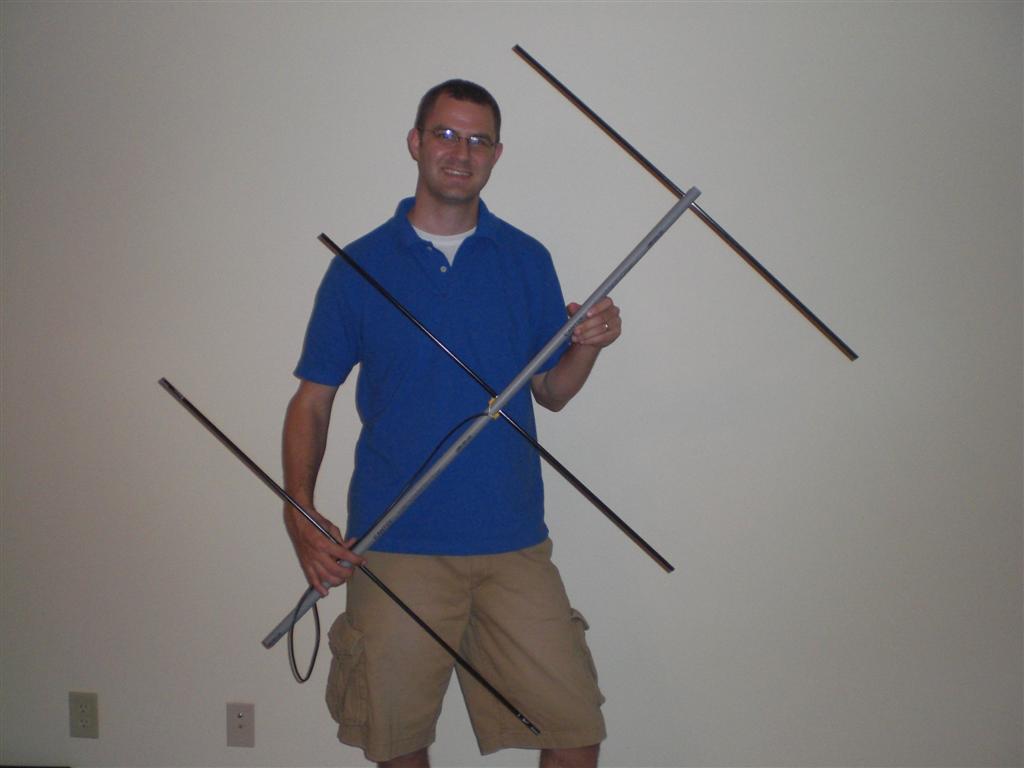
radioDUX Homebrew Arrow YagiThis summer I attended the TI-2 Space workshop put on by the ARRL and DARA in Dayton, OH. We spent 4 days learning how to make contacts with orbiting satellites like AO-27, AO-51 and the International Space Station, just to name a few. The antenna we used was the dual-band Arrow II Antenna. I've owned one for years and really like it. I wish more people had them, but I think most people think spending $140 for an antenna that can only handle 10W is a bit much.

My aim was to make a cheap alternative to the Arrow that is easy to break down for transport and storage. I really like the idea of using aluminum arrow shafts for elements; they are lightweight, straight, weather resistant, and fairly inexpensive. Another nice feature is the #8-32 threaded insert for broad heads that almost every arrow comes with.

I spent a couple of hours reviewing all the "cheap" and "ugly" yagi designs, as well as others like the "tape measure" and even a new-to-me "backpacker" design. They each have their own advantages and loyal followers.

I finally based my antenna design on one found in the ARRL Handbook from 1999. While not an exact replica, my design is very similar. I had decided to go with the through-boom design like the Arrow, as opposed to side-mounted because it is, in my opinion, cheaper. After buying 6 arrows and a quick trip to Lowe's I had a length of #8-32 all-thread and a piece of 3/4" conduit to use as the boom. I marked a straight line down the center of the boom to give me a point of reference, measured out the spacing holes, made sure I was drilling square and level and got to work. After the 3 holes were drilled, I cut 2.5" lengths of all thread for the director and reflector. Since I was going with the split driven element design of the IDX yagi, I would not need threading for the Driven Element, I'd use machine screws for that. Originally I planned to use nylon 8-32 all-thread to go through the boom for the driven element, and feed each side independently similar to the Tape Measure Yagi, but I couldn't find nylon all-thread, and the longest nylon screws to be found came up an inch too short.

I cut a length of RG-58 cable and soldered on two o-ring connectors to slip over the machine screws before screwing on an arrow.
Lastly I cut each arrow to the appropriate length, which worked out to:
- 19 5/8" for each Reflector arrow
- 18 1/8" for each Driven arrow
- 17 1/8" for each Director arrow
The measurements came from IDX's lengths, subtracting 3/4" (for the boom) and then divided by 2 to give me the necessary length for each arrow.
I used a cutoff wheel and my air compressor to cut the arrows to length instead of a hacksaw. The cutoff wheel leaves a clean cut as opposed to sawing.

After putting my MFJ-269 analyzer on the yagi, I found the lowest SWR to be about 1.4 right around the target frequency of 144.490 MHz. Not too shabby for a first yagi.
For those taking my lead, I found it helpful to feed the yagi as perpendicular to the boom as possible. It is also somewhat important for the O-ring feedline connectors to be on the same side of the boom as the arrow.

Here's a pic of me holding the 2m yagi. It's a bit larger than the commercially made Arrow.

update: I've been asked by more than one person why the split driven element. As you read above, it was semi forced on me by necessity. I needed it to be split for mechanical reasons. the screws going through the boom serve as a match, negating the need for the "hairpin" match from the tape measure yagi or a gamma match. The driven elements being split probably do affect the radiation pattern in the long-field, but perhaps only skew the pattern more in one direction.
(TLDR: it's easier that way and it just works!)

update #2: Hello Hack-A-Day! Yes, you can talk to the space station and many other amateur radio satellites.
update #3: Okay, for those that are interested, I'll be putting together kits if you want. Price to be determined based on what you want/need. You can email me at tommy@neodux.com for more info.